Rucking Calorie Calculator — Estimate Calories Burned for Fitness & Weight Loss
Rucking is one of the most effective and underrated ways to burn calories, build endurance, and strengthen your entire body — without needing expensive gym equipment or a gym membership. If you have ever wondered how many calories does rucking burn, you are definitely not alone.
Thousands of people start rucking every month to lose weight, improve cardiovascular health, or prepare for hiking and tactical fitness. But most of them struggle to estimate their calorie burn accurately because regular walking calculators simply do not account for the added resistance of a weighted backpack.
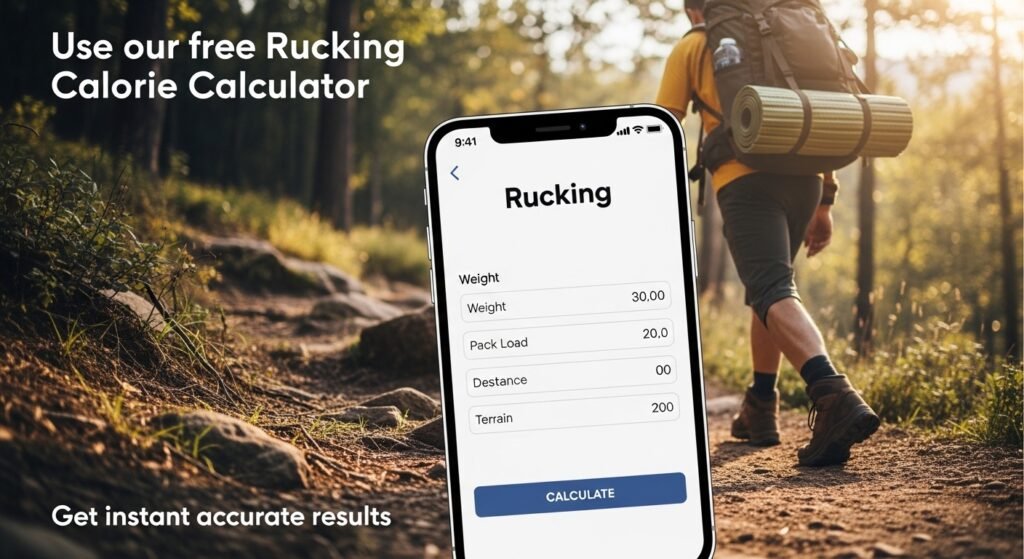
That is exactly why we built this Rucking Calorie Calculator — a fast, free, and accurate tool that estimates your calorie burn based on real rucking variables including body weight, pack load, pace, distance, and terrain type.
Whether you are pushing through hilly trails, marching on mountainous routes, or walking on flat roads with a loaded pack, this calculator gives you a detailed calorie breakdown in seconds.
🎒 Rucking Calorie Calculator
Estimate calories burned based on your weight, pack load, pace, distance & terrain
What Is a Rucking Calorie Calculator?
A Rucking Calorie Calculator is an online tool that estimates how many calories you burn while rucking — which means walking or hiking with a weighted backpack (also called a rucksack).
Unlike a standard walking calorie calculator, a rucking calculator factors in the extra resistance your body faces when carrying a loaded pack. This is important because rucking typically burns 40% to 60% more calories than regular walking at the same pace and distance.
Why Does This Matter?
If you are using a regular walking calculator to estimate your rucking calorie burn, you are likely underestimating your results by hundreds of calories. Our tool fixes that by including pack weight, terrain difficulty, pace intensity, and personal metrics like age and gender.
Think of it this way — a 180 lb person walking 3 miles on flat ground might burn around 300 calories. But add a 30 lb rucksack and some hills? That same person could burn 500 to 700 calories for the same distance.
Why Does Rucking Burn More Calories Than Walking?
Rucking burns significantly more calories than regular walking because your body has to work harder in multiple ways simultaneously.
When you ruck, your body must:
- Carry extra weight from the pack, increasing total energy expenditure
- Stabilize your core more aggressively to maintain balance
- Engage more leg and glute muscles to propel additional load forward
- Increase oxygen demand which raises heart rate and metabolic output
- Maintain posture and balance under load, activating back and shoulder muscles
This combination of factors makes rucking a uniquely powerful exercise for:
- Fat loss and weight management
- Cardiovascular endurance training
- Hiking and backpacking preparation
- Tactical and military fitness training
- Building stronger legs, core, and back
- Low-impact cardio that is easier on joints than running
According to exercise science research, loaded walking (rucking) at moderate pace can produce metabolic demands similar to jogging — but with significantly less joint impact. That is why rucking has become one of the fastest-growing fitness activities worldwide.
Key Features of Our Rucking Calorie Calculator
This tool was built from the ground up to be modern, accurate, and incredibly easy to use. Here is what makes it different from other calculators you might find online.
1. Body Weight Input
Your body weight is one of the biggest factors affecting calorie burn. Heavier individuals generally burn more calories because moving more total mass requires more energy. Our calculator uses your weight in pounds to personalize results.
2. Age Adjustment
Metabolism naturally changes with age. Our tool applies a slight metabolic adjustment for users over 30, ensuring that calorie estimates remain realistic and not inflated.
3. Gender Selection
Males and females have different average metabolic rates. The calculator includes a simple male/female toggle that fine-tunes the calorie estimate based on gender-specific metabolic differences.
4. Distance and Duration
Instead of forcing you to calculate your own walking speed, our tool takes your distance in miles and duration in minutes, then automatically calculates your pace. This makes data entry faster and more intuitive.
5. Pack Weight Slider
This is the most important rucking-specific feature. A smooth slider lets you select your backpack weight from 0 to 80 lbs. The calculator then factors this load into the calorie equation using proven exercise science formulas.
6. Terrain Selection
You can choose from three terrain types:
| TerrainCalorie ImpactBest ForFlatBaseline (no bonus)Roads, sidewalks, tracksHilly+25% calorie boostRolling trails, park routesMountainous+50% calorie boostSteep trails, mountain paths |
|---|
Terrain is often called the “hidden factor” in calorie burn because many people underestimate how much hills increase energy expenditure.
7. Detailed Results Dashboard
After calculating, you get a complete breakdown including:
- Total calories burned
- Calories per hour
- Calories per mile
- Pace (minutes per mile)
- Total body load (body weight + pack)
- Pack impact percentage
- Terrain bonus percentage
- Intensity level indicator (Low, Moderate, High)
- Visual comparison chart: Rucking vs Walking
8. Mobile-Friendly and 100% Free
This is a rucking calorie calculator without signup — no account required, no hidden charges, no email needed. It works perfectly on desktop computers, tablets, Android phones, and iPhones.
How to Use the Rucking Calorie Calculator (Step-by-Step Guide)
Many users search for how to use rucking calorie calculator because most online tools are confusing or require too many inputs. Our calculator was designed to be beginner-friendly while still providing advanced accuracy.
Here is exactly how to use it:
Step 1 — Enter Your Body Weight
Type your weight in pounds into the first field. For example, if you weigh 180 lbs, enter 180.
This ensures the calorie calculation matches your body size, since heavier individuals burn more energy during physical activity.
Step 2 — Enter Your Age
Type your current age. For example, 28.
Age matters because metabolic efficiency changes over time. The calculator makes small adjustments to keep estimates realistic for all age groups.
Step 3 — Select Your Gender
Click either Male or Female. This toggle adjusts the calculation based on average metabolic rate differences between genders.
Step 4 — Enter Distance in Miles
Type the total distance of your ruck in miles. For example, 3.5 miles.
For best accuracy, use a GPS tracking app like Strava, MapMyWalk, or Apple Health to measure your actual distance rather than estimating.
Step 5 — Enter Duration in Minutes
Type the total time you spent rucking in minutes. For example, 55 minutes.
The calculator will automatically compute your pace (minutes per mile) from the distance and duration you entered.
Step 6 — Set Your Pack Weight
Use the slider to select your backpack weight. Slide it to match your actual pack load. For example, 25 lbs.
If you are unsure of your pack weight, weigh your loaded backpack on a bathroom scale before your ruck.
Step 7 — Choose Your Terrain
Click one of the three terrain options:
- Flat — for roads, sidewalks, and level paths
- Hilly — for routes with moderate elevation changes
- Mountainous — for steep trails with significant climbing
Choose the terrain that best matches the majority of your route.
Step 8 — Click Calculate
Press the green Calculate Rucking Calories button.
Step 9 — Review Your Results
Your complete calorie breakdown will appear instantly, including total calories, per-hour and per-mile rates, intensity level, and a visual comparison showing how much more you burned compared to regular walking.
Step 10 — Use the Data to Plan Your Training
Use your results to:
- Set weekly calorie burn targets
- Plan progressive overload (adding distance or pack weight)
- Track fitness improvements over time
- Calculate your daily calorie deficit for weight loss
How Many Calories Does Rucking Burn? (Realistic Examples)
One of the most common questions people ask is how many calories does rucking burn. The answer depends on several variables, but here are realistic examples based on common scenarios.
Example 1 — Beginner Ruck (Light Load, Short Distance)
| Variable | Value |
|---|---|
| Body Weight | 160 lbs |
| Distance | 2 miles |
| Duration | 45 minutes |
| Pack Weight | 10 lbs |
| Terrain | Flat |
Benefits of Using a Rucking Calorie Calculator
A calorie calculator is not just a number generator — it is a powerful training and fat-loss planning tool.
Saves Time
Instead of guessing or doing manual math, you get accurate results in seconds. Enter your data, click calculate, and you are done.
Provides Better Accuracy Than Walking Calculators
Most online calorie calculators only account for walking speed and body weight. Our rucking calculator includes pack weight, terrain type, and pace intensity — the three factors that make rucking different from regular walking.
Helps With Weight Loss Planning
Knowing your calorie burn allows you to:
- Calculate your daily calorie deficit
- Set realistic weekly fat-loss targets
- Plan meals around your activity level
- Avoid overeating or undereating on training days
For context, you need to burn approximately 3,500 calories more than you consume to lose one pound of body fat. If your rucks burn 500–700 calories each, you can see how rucking 4–5 times per week can create a significant calorie deficit.
Tracks Training Progress Over Time
By recording your calculator results after each ruck, you can track improvements in:
- Total calories burned per session
- Pace improvements
- Distance increases
- Progressive pack weight increases
This data-driven approach keeps you motivated and helps you avoid training plateaus.
Works on Any Device — No Signup Required
This calculator is completely free, requires no account creation, and works on mobile phones, tablets, and desktop computers.
You can also check your exact age for fitness planning or use our BMI Calculator to check your body composition before starting a rucking program.
Who Should Use This Rucking Calorie Calculator?
This tool is designed for anyone who walks, hikes, or trains with a weighted backpack.
Beginners
If you are new to rucking and searching for the best rucking calorie calculator for beginners, this tool was built with you in mind. The simple interface, clear labels, and helpful tips make it easy to get started even if you have never tracked calories before.
Weight Loss and Fitness Users
People who want low-impact fat burning will find this calculator invaluable for planning workouts and tracking calorie deficits. You can pair your rucking data with our Percentage Calculator to easily calculate your fat loss percentage over time.
Hikers and Backpackers
If you are preparing for long hikes with gear load, this calculator helps you understand how much energy you will expend on the trail. This is critical for meal planning and nutrition on multi-day hikes.
Tactical and Military Fitness
Rucking is a foundational component of military fitness programs. Soldiers, first responders, and tactical athletes can use this tool to quantify training loads and ensure they are meeting fitness benchmarks.
Athletes and Cross-Trainers
Many athletes use rucking as a low-impact cross-training method. It builds leg and core strength while providing cardiovascular benefits without the joint stress of running.
Advanced Tips to Burn More Calories While Rucking
Once you have a baseline from the calculator, use these strategies to progressively increase your calorie burn.
1. Increase Distance Before Adding Weight
The safest way to progress is to add mileage first. Walk farther before you walk heavier. This builds your aerobic base and conditions your joints and connective tissue for heavier loads later.
2. Add Pack Weight Gradually
Increase your pack weight by 5 lbs every 2–3 weeks. Jumping too quickly can lead to back pain, knee issues, or shoulder strain.
3. Use Interval Pacing
Try alternating between easy and fast walking segments during your ruck:
- 5 minutes at easy pace
- 3 minutes at fast pace
- Repeat for the duration of your ruck
This interval approach increases average heart rate and calorie burn without requiring a heavier pack.
4. Add a Hill Route Once Per Week
Incorporating one hilly ruck per week can boost your weekly calorie burn significantly. Terrain changes challenge different muscle groups and increase cardiovascular demand.
5. Focus on Posture and Form
Correct rucking form helps you move efficiently and reduces injury risk:
- Keep your chest up and shoulders back
- Engage your core throughout the ruck
- Take shorter, quicker steps rather than long strides
- Keep your neck neutral — do not look down at the ground
- Tighten your pack straps so the load sits high on your back
6. Stay Hydrated
Long rucks can drain electrolytes quickly, especially in warm weather. Aim to drink at least 4–6 oz of water every 15 minutes during your ruck. Consider adding electrolyte tablets for rucks longer than 60 minutes.
7. Track Every Session
Use the calculator after every ruck and keep a simple log. Over weeks and months, you will see clear progress in distance, pace, load, and calorie burn. This tracking habit is one of the strongest predictors of long-term fitness success.
If you are planning for long-term health goals alongside your fitness journey.
Common Mistakes to Avoid When Rucking
Avoiding these common errors will help you get better results and stay injury-free.
1. Starting With Too Much Weight
Many beginners load up 40+ lbs on their first ruck and end up with sore knees, back pain, or worse. Start light (10–15 lbs) and build up gradually.
2. Using Estimated Distance Instead of GPS
Guessing your distance leads to inaccurate calorie calculations. Use a GPS app to track your actual route distance.
3. Selecting the Wrong Terrain
Choosing “flat” when your route had significant hills will underestimate your calorie burn. Choose “mountainous” when your route was mostly level road will overestimate it. Be honest with the terrain selection for the best results.
4. Ignoring Rest Time
If you stopped for 10 minutes during your ruck to rest or take photos, your active rucking time is shorter than your total elapsed time. For the most accurate results, enter only your active moving time into the duration field.
5. Wearing the Wrong Footwear
While this does not affect the calculator, wearing unsupportive shoes during rucking is one of the fastest ways to develop blisters, shin splints, or foot pain. Invest in sturdy boots or trail shoes with good ankle support.
The Science Behind the Rucking Calorie Formula
For those interested in the methodology, here is how our calculator estimates calories burned.
The calculation is based on MET (Metabolic Equivalent of Task) values from exercise science research, combined with load-carrying adjustments inspired by the Pandolf equation — a military-developed formula for predicting energy expenditure during loaded walking.
Frequently Asked Questions About Rucking Calorie Calculator
Is this Rucking Calorie Calculator free to use?
Yes. This calculator is 100% free with no payment, subscription, or hidden charges. You can use it as many times as you want.
Can I use this calculator on my phone?
Absolutely. The tool is fully responsive and works smoothly on Android phones, iPhones, iPads, and all tablet devices. No app download is required — it runs directly in your mobile browser.
How accurate is the rucking calorie calculator?
The calculator provides realistic estimates based on proven exercise science formulas. It accounts for body weight, age, gender, distance, duration, pack weight, and terrain type. For best accuracy, use GPS-tracked distance and enter your actual active rucking time.
Does the calculator require me to create an account?
No. This is a rucking calorie calculator without signup. You can use it instantly with no email, no registration, and no personal data stored.
What is the best rucking pace for burning fat?
A pace between 18 and 22 minutes per mile with moderate pack weight (20–30 lbs) is generally ideal for fat burning. This pace keeps your heart rate in the aerobic fat-burning zone without causing excessive fatigue or joint stress.
Can I use this calculator for hiking with a backpack?
Yes. Rucking and hiking with a loaded backpack are biomechanically very similar. Select the terrain type that best matches your hiking route for the most accurate results.
How much pack weight should beginners start with?
Most beginners should start with 10–15% of their body weight. For a 180 lb person, that means a 18–27 lb pack. Start on the lighter end and increase by 5 lbs every few weeks as your body adapts.
Is rucking better than running for weight loss?
For many people, yes. Rucking burns a comparable number of calories to jogging but with significantly less impact on joints. This means you can ruck more frequently with less recovery time needed, potentially burning more total calories per week than a running program.
How often should I ruck for weight loss?
Most people see excellent results rucking 3 to 5 times per week with at least one rest day between sessions. Start with 3 sessions per week and increase frequency as your fitness improves.
Does rucking build muscle?
Yes. Rucking primarily strengthens your calves, quadriceps, hamstrings, glutes, core, and upper back. While it will not build muscle like heavy weightlifting, it is excellent for developing muscular endurance and functional strength.