Period Calculator: Predict Your Cycle & Boost Your Health
Imagine this: No more guessing when your period will arrive. No more last-minute scrambles for supplies. Just clear, accurate predictions, giving you control over your body and your plans. This isn’t a dream; it’s the reality offered by modern period calculator. But with so many options, how do you find the best one? And how can understanding your cycle truly empower you?
Cycle & Fertility Tracker
What Exactly Is a Period Calculator?
At its core, a period calculator is a digital tool that estimates the start date of your next menstrual period, and often your ovulation and fertile window, based on the information you provide about your past cycles.
It uses simple math, but the best ones integrate advanced algorithms and educational content to give you much more than just a date.
Why You Need a Period Calculator in Your Life (Beyond Just Tracking)
While predicting your next period is the primary function, the benefits extend far beyond:
- Pregnancy Planning (or Prevention): By pinpointing your fertile window, you can increase your chances of conception or know when to be extra cautious if avoiding pregnancy.
- Health Insights: Irregular periods can signal underlying health conditions like PCOS, thyroid issues, or stress. Tracking helps you identify patterns to discuss with your doctor.
- Mood & Energy Management: Ever notice you feel more energetic at certain times of the month? Or more irritable? Understanding your cycle phases allows you to anticipate these shifts and plan accordingly.
- Optimal Performance: Many athletes track their cycles to understand how hormonal fluctuations impact their strength, endurance, and recovery.
- Peace of Mind: Simply knowing what to expect reduces anxiety and allows you to plan social events, vacations, or even just your workout schedule with confidence.
The Science Behind the Prediction: How Do They Work?
Most period calculators rely on two key pieces of information:
- The first day of your last period (LMP).
- Your average cycle length.
A “standard” cycle is often cited as 28 days, but this is merely an average. Normal cycles can range from 21 to 35 days.
Here’s the basic calculation:
- Next Period Due Date: LMP + Average Cycle Length
- Ovulation Day: Next Period Due Date – 14 Days (The luteal phase, from ovulation to period, is usually 12-16 days long, with 14 being common).
- Fertile Window: Typically 3-5 days before ovulation and 1 day after ovulation. This is because sperm can survive for several days in the female reproductive tract.
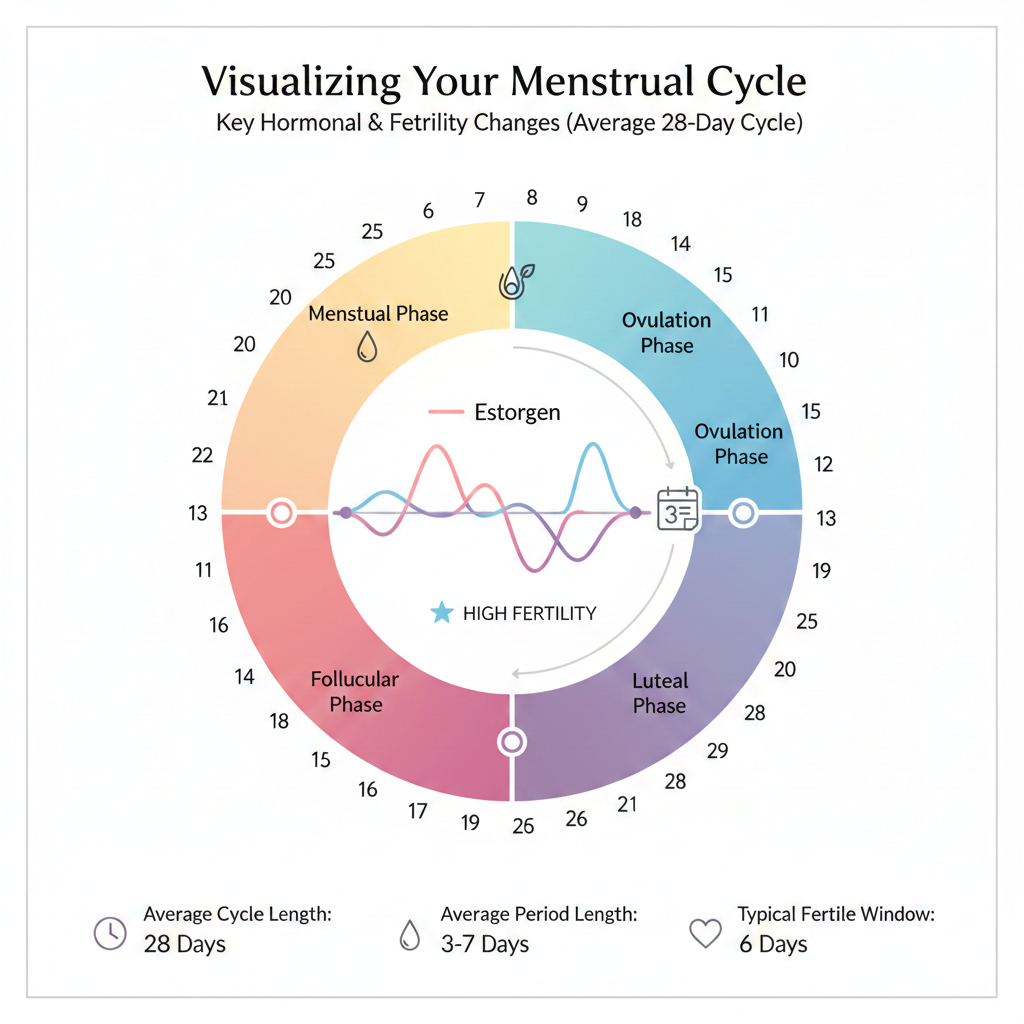
Visualizing Your Cycle
Introducing Our Elite Period & Ovulation Predictor
We’ve designed a calculator that goes beyond basic predictions. It’s fast, accurate, and prioritizes your privacy.
Why ours ranks first:
- 100% Private: Your data stays on your device. We don’t track, store, or sell your personal health information.
- Intuitive Design: Clean interface, easy to use on any device.
- Accurate Algorithms: Uses clinically relevant averages for ovulation and fertile window.
- Instant Results: Get your predictions in seconds.
Beyond the Calculator: Understanding Your Cycle Phases
Knowing your dates is one thing; understanding what’s happening inside your body each week is another. Your menstrual cycle isn’t just about your period; it’s a dynamic interplay of hormones influencing your mood, energy, skin, and even your focus.
Here’s a simplified look at the four main phases:
- Menstrual Phase (Days 1-5, approx.):
- What’s Happening: Your uterine lining sheds, resulting in bleeding. Estrogen and progesterone are at their lowest.
- How You Might Feel: Lower energy, cravings, may prefer rest.
- Follicular Phase (Days 1-13, approx.):
- What’s Happening: Estrogen starts to rise, stimulating follicle growth in the ovaries. Your uterine lining begins to thicken again.
- How You Might Feel: Energy levels increase, often feel more focused and social.
- Ovulation Phase (Day 14, approx., for a 28-day cycle):
- What’s Happening: A surge in Luteinizing Hormone (LH) triggers the release of an egg from the dominant follicle. Estrogen peaks.
- How You Might Feel: Peak energy, libido often increases, heightened senses. This is your most fertile time!
- Luteal Phase (Days 15-28, approx.):
- What’s Happening: Progesterone rises (along with some estrogen), preparing the uterus for potential pregnancy. If no pregnancy occurs, hormone levels drop, triggering your next period.
- How You Might Feel: Energy may dip, some experience PMS symptoms (bloating, mood swings), may crave comfort foods.